Debugging a Beier-Neely Image Morph
What 26 line pairs, five transformation studies, and several coordinate bugs taught me about image warping.
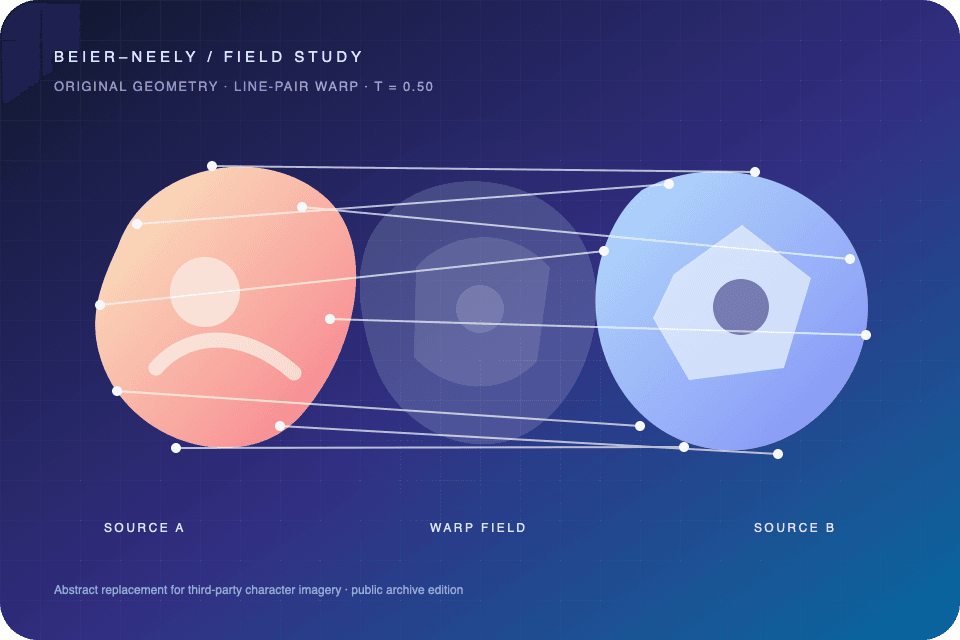
Beier-Neely morphing creates a smooth transition between two images by using corresponding line pairs as geometric constraints. Each intermediate frame interpolates those lines, warps both source images toward the new geometry, and then dissolves their color values.
For the character study, I placed 26 line pairs around the silhouette and important local features. More lines gave me control, but they also made errors easier to amplify.
The first bug was a coordinate convention
Eigen image matrices are addressed as rows and columns. The morphing equations are expressed in geometric x-y coordinates. I initially treated those conventions as interchangeable, which sent otherwise correct calculations into the wrong image axes.
The fix was simple once the problem was visible: define one conversion boundary and keep every warp calculation in a consistent coordinate system.
Jitter came from integer conversion
The translated sequence shook vertically during its early frames. Changing line-pair length did not help, nor did adding more pairs for stabilization.
The actual cause was inconsistent conversion from floating-point warp positions to integer pixels. Some paths truncated, others rounded, and boundary handling differed. A consistent clamp and rounding strategy produced the smoothest translation.
Linear interpolation won
I tried several strategies for generating intermediate line pairs, including sine-shaped blends. Linear interpolation produced the least distortion. It was also the easiest behavior to reason about while debugging—simple made the system more legible.
Imperfect results are still useful results
Translation became stable, while scale remained only moderately successful. Rotation moved in the opposite direction from the expected result, pointing to a remaining issue in the warp or position calculation.
The archived morphing study preserves five original 31-frame sequences: translation, translation with scale, 2D scaling, rotation, and the character morph. The character sequence retained a small ghosting artifact around the left leg. Comparing one line pair per leg with eight produced nearly the same result, so increasing line count alone did not resolve it. Those original frames document both the improvements and the remaining defects. The abstract warp field and four clips below are replacement visuals and reconstructed demonstrations. Use the archive to inspect the actual outputs behind this debugging account.
Migrated experiment
Warp field + four transformation studies
Original abstract field
plus reconstructed tests
Archive note: the old character source images are not republished because their original credit and publication license were not retained. The abstract field above was created for this archive; the four geometric videos preserve the implementation and debugging record without the third-party artwork.